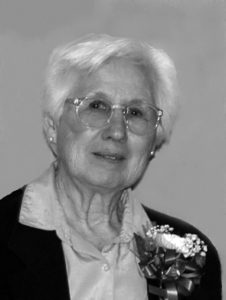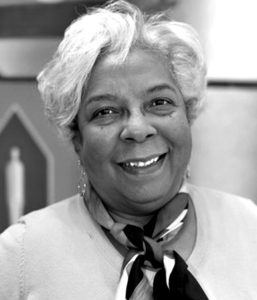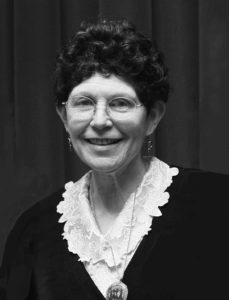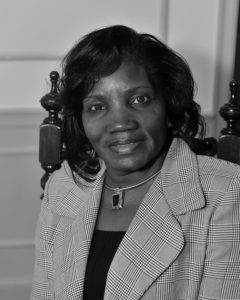
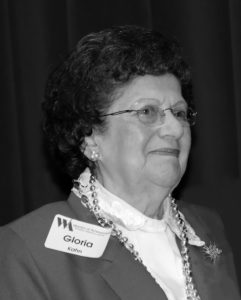
Gloria Kahn

Women of Achievement
2009

STEADFASTNESS
for a woman with a lifetime of achievement:

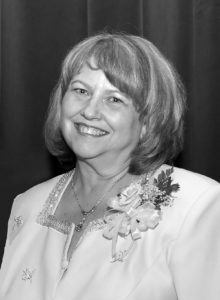
Gloria Kahn

Gloria Kahn’s community leadership began with bandage rolling during World War II and continues in the highly technical and explosive push for embryonic stem cell research in 2009. In more than 60 years, she has advocated for people and ideas here and throughout the world.

“She has been a leader, not just by words, but by example,” said one nominator. Asked why she always worked on community affairs, while so many did so little, Gloria said, “Because it has to be done. Not everybody wants to take on some of the things I take on (because) they’re controversial or time-consuming.”

This child of Russian immigrants, born in Memphis, was imbued with love, respect for and appreciation of the United States by her parents. She won a citywide essay contest on “What America Means to Me.” She was in college at Southwestern (now Rhodes) when World War II was declared. Wanting to help the war efforts, she became a Red Cross Nurse’s Aide volunteering at the veteran’s hospital.

Marriage and two children led to volunteering as a Girl Scout troop leader – an acquaintance that later equipped her for a paid job as a field director and public relations director for the Tenn-Ark-Miss Girl Scout Council.

Her political activity began when she served as co-manager of President John F. Kennedy’s East Memphis campaign office. She served various leadership positions with the Memphis Women’s Political Caucus and the League of Women Voters and was a co-founder of the Public Issues Forum of Memphis, organized to bring greater advocacy for the Constitutional mandate of separation of church and state. She was its first president. Because of her passion for this issue, she was elected to the National Advisory Council for Americans United for Separation of Church and State. She was West Tennessee Vice President of the Tennessee Federation of Democratic Women.

Other community volunteering included the Girl Scout Council, Council on Aging, Panel of American Women, Orange Mound Day Nursery, president of Theatre Memphis’ auxiliary Stage Set and fundraising steering committee for the Med.

For more than 50 years, Gloria has been a leader in Hadassah, the nation’s largest women’s volunteer organization. A member of a four-generation life-member family, she has served every position of leadership, including president, in the Memphis chapter and on the Southern Region Board. She also has been president of local and regional chapters of B’nai B’rith Women, the Anti-Defamation League and on the board of the Memphis Jewish Community Relations Council, Health Insurance Continuance in Tennessee and Beth Shalom Synagogue.

For 13 years, Gloria was chairperson of the Memphis Committee on Soviet Jewry, part of a national effort to give a voice to Jews and others who wanted to leave the Soviet Union but were denied visas simply because of their religion.

With the National Conference of Christians and Jews, she was instrumental in organizing the Interfaith Task Force on Human Rights and Religious Liberty. Through her involvement with Hadassah and Americans United, Gloria has taught others to lobby for issues in which they believe and she has led lobbying trips to Nashville and to Washington D.C. Former mayoral candidate Carol Chumney wrote of Gloria: “She would have been a fine candidate for office herself, based upon her knowledge, compassion, commitment, dedication and passion for improving our community. Yet, she chose to instead selflessly work to help other women, like myself, get their foot in the door in an arena in which women often struggle to gain equal participation.”

Despite repeated health challenges, Gloria Kahn remains devoted and dedicated to urgent causes. She almost single-handedly organized a community coalition to prepare and position legislation for state support of stem cell research. She only slowed that effort a bit last year after local legislators indicated that they were not ready to negotiate for it across the state! With new federal leadership open to scientific endeavor, she is ready with a revived campaign for Tennessee.

She helped plan and attended a reception for female state legislators in October even after another illness.

This champion of social change, of women’s rights, of progressive issues has steadfastly served our community as a leader on political, social and civic issues. And she’s not done yet! Gloria Kahn is the 2009 Woman of Achievement for Steadfastness.
Carolyn Gates

Women of Achievement
2008

STEADFASTNESS
for a woman with a lifetime of achievement:

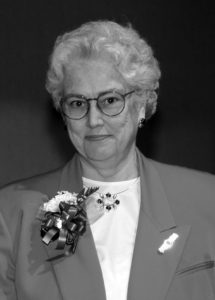
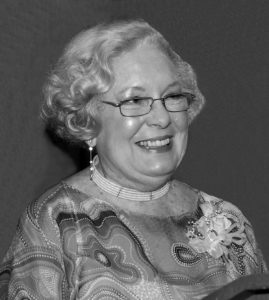
Carolyn Gates

Carolyn Gates grew up sewing for 4-H contests and pampering her pet cow in Geiger, Ala., population 72.

When she was 59 and the comfortable wife of a successful businessman, she ran for mayor of Shelby County, population 830,000.

She was the first woman to run for county mayor.

Why would she do such a thing?

She says, “I always tried to show that if you care enough, if you work hard enough, you can do almost anything. My mission became to encourage women to think in terms of what is possible for them. If I can do it, other women can too.”

The journey from 4-H sewing contestant to mayoral candidate curved first through the University of Alabama business school where she met her husband-to-be Jim Gates. She planned to return to college after they married but that got put off until the three children were all in school. The family had located to Memphis so Carolyn earned a psychology degree, one course at a time, at Memphis State, graduating with honors in 1975.

By then she had been a staunch Republican volunteer for 15 years. She served as precinct captain, area chairman, women’s chairman of the Republican Party of Shelby County and later president of the Republican Career Women. She was co-chair of Richard Nixon’s campaign in Shelby County both times he was elected, in 1968 and 1972. She was Shelby County campaign manager for Gerald Ford and George W. Bush.

She was her own contractor when she and Jim built their house in Germantown in the 1970s. “I was the quintessential volunteer – president of the PTA, president of the women of the church, a room mother. We were the family of the 50s, Ozzie and Harriet.”

But her eyes were opening.

“I saw so many areas where women should be serving and there were none, only men,” Carolyn says. “I found an amazing amount of skepticism about a woman, a wife and mother, running for public office.”

In 1977, when she first ran for Shelby County Commission, she recalls a “fairly typical” conversation with “one of our civic leaders.” After hearing Carolyn’s plan to run for office, he reared back in his chair, propped his feet on his desk, looked her in the eye with a benevolent smile and said, “Little lady, you are a nice, pretty little housewife. You’ve been happily married for 20 years. Now go back home where you belong.”

She was amazed that she was only the second woman to serve on the County Commission. Her husband got phone calls asking him to tell his “little woman” to do this or that. He firmly explained he didn’t vote on the county commission and his wife didn’t make real estate decisions.

After 17½ years on the county commission, including being the first woman to chair the budget committee and then the first woman to chair the commission, Carolyn ran for mayor in the primaries against fellow commissioner Jim Rout in 1994. Carolyn did well in early polling but suddenly plummeted into a two to one victory margin for Rout.

Carolyn was a founding member of the Salvation Army Auxiliary and of Youth Villages. She was chair of the Salvation Army Advisory board and the Memphis State National Alumni Association. She was appointed to the Defense Advisory Committee on the Status of Women and to the state Commission on the Status of Women. She is a life member of the Shelby County PTA who has hosted benefits and fundraisers for more than 50,000 people in her home in the past 25 years.

After nearly 18 years in the county commission, Carolyn worked in financial services and real estate and continued to contribute articles to local newspapers. She has often spoken in defense of women who focus on home and community instead of career but urges all women to participate fully in life.

For her lifetime of standing up, speaking up and participating fully in Shelby County life, Women of Achievement salutes Carolyn Gates. Carolyn remembers a visit to a family cemetery long, long ago.

Graves of the men were marked with reverent epitaphs of their success as teachers, preachers, leaders and heroes.
Graves of the women said “Dear Mother of George and two Daughters” or “Loving Wife of Henry.”

“I suppose it didn’t need to be spelled out for us that these, too, were heroic acts,’ Carolyn says. ‘These women gave birth to the babies, nurtured the living and buried the dead (but today’s women) must carry on the responsibilities of the past (and) also exploit the talents and special qualities that women carry within them…

“Will the epitaphs of these women who change the course of history read ‘Dear mother of George and two Daughters’ or “Loving Wife of Henry?” Maybe, and there’s nothing wrong with that. It’s noble. But there is much more. So very much more. I’m reminded of the proverb that says, ‘If it is to be, it is up to me’ I believe it!”

Gertrude McClellan Purdue

Women of Achievement
2007

STEADFASTNESS
for a woman with a lifetime of achievement:

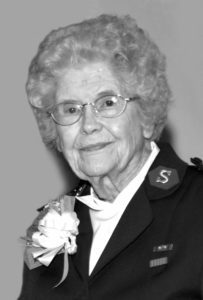
Gertrude McClellan Purdue

Born in Ohio in 1909, Gertrude Purdue came into this world serving others. Through six wars, the great depression, and the Civil Rights movement, she’s been, in her own words, a handmaiden to the Lord. Her energy and dedication have benefited countless people. She’s the first to arrive for a meeting and the last to leave. She has a smile that lights up the room and a Salvation Army uniform that still fits.

The oldest of seven siblings, Gertrude was raised in Michigan and Indiana. The daughter of Salvation Army officers, she was serving doughnuts to servicemen and veterans by the time she was 9. At age 13, she was helping conduct summer camps for disadvantaged children. In a recent interview in The Commercial Appeal, she said, “We were children of the regiment, and I had a flock.”

She became a commissioned Salvation Army Officer in 1930. In 1934, she married fellow officer Bramwell Purdue. They had two daughters and a son and raised a foster daughter. Together the two served in five cities in the Southern Territory for almost 30 years.

The couple helped form one of the first USO clubs and went on to direct several others. In the 50s, W. B. Purdue served as divisional secretary while Gertrude worked with nursing homes and hospitals.

They came to Memphis in 1962 to serve as Area Commanders. During their years of active service they helped develop a shelter for abused and exploited women and children. Gertrude worked to develop social services including senior citizens programs and with the Junior League, established one of the city’s first daycares for low-income families. Working with the Memphis Parks Commission, she and her husband helped create Golden Age Clubs, recreational and learning clubs for senior citizens that were so popular that the parks service later developed their own.

In addition to her work with the Salvation Army, Gertrude has been a part of Church Women United since the group began, serving as both state and local president. When Myra Dreifus called asking for help on behalf of the Fund for Needy Children. Gertrude organized a “sew in,” with 250 women sewing 2,500 garments. The “sew in,” now known as a “sew out,” still exists. Following Dr. King’s assassination, she helped organize forums to bring people together to open lines of communication and foster understanding and unity. And she served on the committee that formulated plans for what is now the Memphis Inter-Faith Association.

Gertrude was a board member, officer and advocate for the YWCA when it was first addressed issues of race and women’s equality. This was during the time that the Y was one of the only integrated groups in town.

In 1973, the couple retired from the Salvation Army, but Gertrude kept on serving. A founding member of the Women’s Auxiliary, she’s still chief recruiter. She organized an early discount program for seniors, and played piano at the Adult Rehabilitation Center for 29 years. And she’s still delivers doughnuts at the VA Hospital twice each month.

Gertrude has received many awards but one tops the list. In 2006, she received the highest international honor the Salvation Army bestows: The Order of the Founder is given for superlative service to its mission and ministry. Her photo hangs at Army headquarters in Atlanta and is inscribed with her name and the words “servant” and “encourager.”

Gertrude has remained active in Church Women United and the East Memphis Quota Club and helps keep others motivated and on track. She’s optimistic and believes in setting an example of love. She has said, “….You never know what seed you sow today will grow down the line.”

This May, Gertrude will celebrate her 98th birthday. We know that over all these years, she has steadfastly sown many seeds and continues to do so today. She is certainly an encourager and an inspiration for us all.


Gertrude Purdue died at age 104 in May 2013.

Virginia “Ginger” Ralston

Women of Achievement
2006

STEADFASTNESS
for a woman with a lifetime of achievement:

Virginia “Ginger” Ralston

A native of Missouri, Ginger Ralston was born in Waynesville, raised in Lebanon and attended college in Springfield. She became “Ginger” the summer before her junior year while working a summer job with her friend Stella. Stella gave them both nicknames and Virginia liked Ginger so well that she’s been Ginger ever since.

She and her husband moved to Clarksdale, Mississippi, in 1955, where they lived for the next thirty years. There Ginger raised their three sons, was PTA president and worked diligently for the American Association of University Women and her local garden club.

While raising her family, she decided to follow in the footsteps of her maternal grandmother and her mother and enter the world of property management. When her grandfather died, her grandmother was left with four young children and no income. To support her family, she built three houses to rent to boarders. Her mother inherited one of the houses, which she in turn managed, resulting in college money for Ginger. After Ginger’s youngest child started to school, she bought a lot, built a 24-unit apartment building, which was soon followed by another.

It wasn’t until 1991 that Ginger became active in women’s political issues. That was the year that she discovered that her favorite aunt, Fairy, had died because of the lack of safe and legal abortion. Told by her doctor to avoid the condition, Aunt Fairy had two difficult and dangerous pregnancies resulting in two children. The third pregnancy resulted in this beloved aunt’s death. Ginger was at the university when this happened and never knew what had happened. When she heard the story in 1991 the political became personal and Ginger became actively pro-choice and actively involved in women’s issues.

Since that time Ginger has worked tirelessly for the AAUW, the Women’s Political Caucus and the Unitarian Women’s Alliance, Women of Achievement and the Public Issues Forum. Ginger became well known as someone who could be counted on to be present – and representing multiple organizations – at any significant gathering focused on women’s issues and women’s needs.

Quoting a letter of support from City Council member Carol Chumley, “Mrs. Ralston’s boundless energy, enthusiasm and advocacy for women are remarkable. She is not often out-front but is always working diligently and steadfastly behind the scenes….She is probably the most knowledgeable person in Shelby County regarding the voting records of elected officials and positions taken by candidates for public office on issues affecting women and families.”

Many of us can attest to that. When we open our email accounts we’re very likely to find a message from Ginger updating us on the issues and providing contact information so that our voices can be heard by decisions makers at all levels.

Virginia “Ginger” Ralston passed away on June 20, 2019.

Beverly Greene Bond

Women of Achievement
2012

VISION
for a woman whose sensitivity to women’s needs
led her to tremendous achievements for women:

Beverly Greene Bond

History is central to a society. History interprets how a society operates and defines the role of people within that society. By looking at how the past has led to the present, history is a means of assessing and even possibly shaping the future.

Dr. Beverly Bond has been a leader in advancing both of those roles for history and for women. Her research and writing exploring the ways 19th century African American women negotiated the boundaries of race, class and gender have led to a new appreciation of the contributions and challenges of women of color in Southern and national society. Her work contributes to the recognition of how women approached and affected social and public policy from their perspectives and on their own terms. Building on that understanding, her current work addresses how women can be leaders in creating positive change for social justice.

The second of five children, Beverly Bond grew up in the 1950s in a strong family with a strong sense of community. Sputnik circled the skies so math and science were encouraged as majors but when she started at Memphis State University in 1963, she remembered her Hamilton High School history teachers Rev. Suggs and Rev. Hawkins. She took a class from the inspirational Marcus Orr and, loving the stories, knew that history was the field for her.

Her family valued education. Her parents quit high school during World War II to marry and raise a family. Later, both parents obtained GEDs and her mother went on to earn a Bachelor’s degree from LeMoyne-Owen. The day Beverly obtained her own Bachelor’s was the day her mother received a Master’s. With several teachers in the family, Beverly joined the family profession. Prior to joining the faculty at the University of Memphis, she taught high school history for 14 years in New Jersey and 11 years in Germantown.

Beverly began her academic career in world civilization. She moved to American history, African-American history, and then focused on the history of African-American women. When she started doing research for her dissertation, she was told there was no information on the topics she wanted to explore. But she remembered growing up in a community supported by neighborhood civic clubs and church groups run by women. Time to go to the polls? The civic club would get out the vote. A death in the community? People would organize to go door to door collecting for flowers. There were social clubs, bridge clubs, and children’s clubs, all requiring various levels of organization. Beverly was sure there must be information somewhere. She started to search. The results can be found in her books, book chapters, journal articles and even encyclopedia articles.

Beverly’s impact goes beyond being a thinker and writer. Dr. Bond is a “doer” through her impact as an exceptional teacher affecting future generations. A recipient of 14 local, state and regional teaching awards, her book Memphis in Black and White, coauthored by Women of Achievement honoree Dr. Janann Sherman, was selected as Best Book on Memphis History in 2004 by the Memphis Historical Society. In 2009, she co-edited Tennessee Women: Their Lives and Times, with Sarah Wilkerson Freeman. She is now working on volume two. After that, she plans to complete Claiming My Self: African American Women in Memphis, Tennessee, 1820s-early 1900s, in which she will examine what it meant for women to go from slavery to freedom while exploring the meaning of “self.”

Reciting a list of her books and awards, though, does not fully express Dr. Bond’s accomplishments. In the best sense of effective history, Dr. Bond’s recognition and documentation of the role of women as political actors and movers in the advance of civil rights in the United States have contributed to the template for advocacy for women’s rights today. Moreover, she lives what she teaches, contributing to the Women’s Foundation for a Greater Memphis and serving as an advisor to the Center for Research on Women and the Benjamin Hooks Institute for Social Change.

Beverly Greene Bond’s vision has contributed to our knowledge of women in our community and expanded our vision of what our shared futures might be.

Cynthia Grant Tucker

Women of Achievement
2011

VISION
for a woman whose sensitivity to women’s needs
led her to tremendous achievements for women:

Dr. Cynthia Grant Tucker

Cynthia Tucker is a woman who has long been devoted, in her own words, to “giving abridged or interrupted voices their due.’’ Her primary focus has been on researching, revealing and showcasing the lives and artistic accomplishments of other women, including women marginalized by race or disability. She has been a “behind the scenes” advocate and mentor for many women, devoting much of her life to showcasing women’s experiences through written and visual expression.

Cynthia came to feminism naturally. She was born in New York City and raised in a nearby New Jersey suburb. Her mother, an underpaid bilingual stenographer, was a lifelong card-carrying member of NOW who gave her daughters inaugural subscriptions to Ms. Magazine. Her father always believed in the abilities of women and treated them with respect.

Like many, Cynthia was motivated to action in the early 1970s by her realization of the need for change in the larger society. She became involved in local politics and served as a delegate to the Democratic National Convention in 1972, supporting the candidacy of Shirley Chisholm. In Miami, she saw that despite having their own agenda, women were not taken seriously, in some cases not even by themselves. She returned to her faculty position at Memphis State determined to ditch politics and take up feminism – and to do this at an institution where the female faculty members were still expected to make the coffee.

Cynthia became passionate about bringing women’s voices and lives to the forefront. She shifted her professional focus from literary criticism to discovering works written by women authors and validating women’s experiences. Unable to convince departmental administrators of the need to change the then primarily male, white canon of literature taught at the university, she began a very popular “Women’s Writings” course through the Continuing Education Department.

At the same time, Cynthia was energized by changes she perceived in the larger world and continued to use that energy to move her department and the university toward greater inclusiveness of vision. In the mid-1970s, Dr. Tucker was part of a major and successful class action suit on behalf of all female employees at the university. She worked to develop the university’s Comparative Literature program and served as its founding director. She also helped midwife the university’s Women’s Studies program, serving on the steering committee for 10 years.

Cynthia began a lecture series, “Women’s Images through Time,” and continued to press for the inclusion of women, including women of color, in the literature curriculum. She taught a groundbreaking course on women’s literature in the 1970s and repeatedly submitted proposals for such courses until they were finally accepted into the standard literature curriculum in the mid-1980s.

She become passionately interested in women’s biographical writing and shifted entirely toward documenting women’s lives. “I wanted to write so that women would see themselves and men would remember that their mothers and sister had full lives.”

It was in a class that Cynthia taught on “Women’s Voices as Writers and Artists” that she met student Patricia Cline, a talented quilter, a woman at midlife living with a severe disability. Already a seasoned biographer, Tucker realized the importance of Cline’s written and fabric work and eventually assembled Cline’s writings and photographs of her work into a wonderful biography, Spirited Threads: A Fabric Artist’s Passion for Life – The Art and Writings of Patricia Roberts Cline which was published shortly after Cline’s death.

Cynthia became interested in the autobiographical and political messages in the visual arts by women and produced several programs and exhibitions on women and art and women artists. Eventually she took up the needle herself and assembled an interracial group of women artists and quilters to complete Pat Cline’s unfinished quilts.

She has authored five biographies of creative and risk-taking women and has lectured, written and taught about many more. Her most recent book is No Silent Witness which details the lives of activist Unitarian Universalist women in the late 19th and early 20th century. That title received the 2010 Frederick C. Melcher Award for Significant Contribution to Religious Liberalism.

In a description of Pat Cline, Cynthia describes “her rage for truth-telling, her stubborn refusal to honor divisive boundaries and her heresy of acknowledging that the personal and the political are cut from the very same cloth.” These words might well be used to describe Cynthia herself. Cynthia Tucker has taken up the torch of ensuring that the courageous lives of women who have gone before us and who live among us, shall not be overlooked or forgotten. This Woman of Achievement’s vision continues to expand our own.

Melvena Leake

Women of Achievement
2010

VISION
for a woman whose sensitivity to women’s needs
led her to tremendous achievements for women:

Melvena Leake

Always highly motivated, Melvena Leake taught school for 30 years, worked as a volunteer probation officer, and sold real estate on the side. She planned to travel when she retired but instead fate and a vision of making a difference in the lives of women just released from prison led her on a different journey.

After retiring, Melvena Leake began visiting women in prison as part of her church’s ministry. She found that many of the women were not first-time offenders but had returned to prison after being released. She listened to their stories and asked questions of her own.

“How many times have you been here? Why do you keep coming back?” she asked. And she started researching recidivism. She found that having a place to go upon release was essential in staying out of jail. And she dreamed of a halfway house that could be that place.

Melvena and her husband postponed their travel plans and she looked for funding to create that house. On December 7, 1999, Karat Place, Inc., a grassroots, non-profit residential rehabilitation program for homeless women ex-offenders, was chartered. It received its 501(c)(3) status in May 2000 and Melvena began accepting in-kind donations and planning operating procedures. In January 2001, Karat Place became an official service provider.

Karat Place is more than a residential facility. Its goal is to prepare women for living-wage employment and to help improve parenting skills so that these women may be successfully reunited with their children. Melvena helps them access medical care and teaches job interviewing and life skills so that they learn to share a vision of a life of their own. The program is called START, Special Transitional Actions to Restore Talents.

Once employed, the women contribute 30% of their wages to the program and save 30%. They apply for food stamps to cover the costs of food. They shop, plan and prepare balanced meals, and do the cleaning. Coming from chaotic past lives, some residents have never before made so much as a grocery list. Children visit on weekends.

Most participants are self-sufficient within the first six months but can stay up to two years.

Karat Place started with 4 beds. The second location had 12, and the current facility has 16.

Karat Place is proud of its first 10 years. Over 200 women have been reunited with their families, have found good jobs, and have stayed out of jail. The hotel industry has been especially helpful, providing jobs in housekeeping. Karat Place “graduates” are supervisors at both the Marriott and the Madison Hotel.

Funding continues to be a challenge. Melvena puts together money from churches, foundations, corporations, individuals, and her own savings. (Remember those travel plans?) She takes no salary for herself.

Hers is a purpose-driven life. The program isn’t faith-based, but that’s how she made it. “What God ordains, he maintains,” she says. She’s quick to point out that she couldn’t do this all alone. It is the work of many hands; volunteers, board members, those who donate both in-kind and in cash.

Asked how she achieves her high success rate, she says that the women know that she believes in them. She’s strict. She knows that some may laugh at her ways, but they all know she cares. Many have returned to thank her.

The age-old measure of value is gold, and thus the name Karat Place. Melvena’s belief in these women and her vision of transforming broken lives into something of beauty and value has become a glowing reality.

Phyllis Betts

Women of Achievement
2008

VISION
for a woman whose sensitivity to women’s needs
led her to tremendous achievements for women:

Dr. Phyllis Betts

No matter which of her community hats Dr. Phyllis Betts may be wearing, she is forever and always vigilant to the rights and needs of women.

A sociologist by training, Phyllis has advocated for women consistently as associate director of the Center for Research on Women and as director of the Center for Community Building and Neighborhood Action at the University of Memphis.

Phyllis was a founder of the Memphis Area Women’s Council where she co-organized the initial action team to address domestic violence with a volunteer court watch. She is the Women’s Council’s leader on its Workforce Action Collaborative which is seeking to identify primary barriers keeping unemployed and underemployed women from good-paying jobs.

Thanks in large measure to Phyllis, the Operation: Safe Community initiative included domestic violence as one of its 15 key issues and action steps to address crime in our community. She says, “Many things that aren’t defined as women’s issues really are and if you strengthen and prepare women to deal with life issues, you’ve gone a long way to prepare our whole community.”

Her multi-layered connections in local grassroots community activism, politics and academia give her constant opportunities to speak up for women’s needs — and she always does. Her commitment is to always “drill down” into the data to find out what it really means to women and to find ways to address the root causes of circumstances that limit women’s equity.

Phyllis grew up in Springfield in central Illinois where state government is the main industry. She attended Southern Illinois University where she found her way into sociology because “it’s about everything and I can’t imagine not being able to think the way I think. Lots of perspectives are important in problem solving.”

With a bachelors’ degree in sociology from Southern Illinois, she completed a Master’s in sociology and then in 1978 earned her PhD from the University of Chicago where she concentrated on social inequality, social policy and urban sociology.

She taught sociology at the University of North Carolina in Asheville. She also founded and directed the UNC Asheville University Honors Program from 1985 to 1990 while also working as associate director of the undergraduate research program.

In 1990, she moved to the University of Memphis where she founded an undergraduate research program and directed the university honors program until 1995. Today, in addition to her research activities, she is associate professor in the School of Urban Affairs and Public Policy. She is a research fellow with the Urban Child Institute and chairs the Shelby County Infant Mortality Initiative Data Committee.

Her work with CROW focuses on poverty, welfare policy and workforce development for women. Unlike many traditional academics, she uses research to drive action – and it is that link that came to life with creation of the Memphis Area Women’s Council. Phyllis and others from CROW, the Women’s Foundation for a Greater Memphis, the University of Tennessee and other activists created the not-for-profit Women’s Council with a mission to change local policy and practices by taking action based on data and research that explain the root causes of problems. The Women’s Council has organized a court watch of domestic violence cases, initiated a girls’ activism project called Girls for Change to address sexual harassment in schools, targeted barriers to good jobs for women through a Workforce Action Collaborative and fought to ban corporal punishment in city schools.

“It’s the rubber meeting the road issues that have always engaged me,” Phyllis says. “Women’s issues can be defined pretty narrowly at times – yet when you look at social and economic issues women are disproportionately affected. So much of what happens in society works its way through women’s lives.”

As long as Phyllis Betts is on watch, women’s rights and women’s needs will be at the table whether the immediate issue is violence, bankruptcy, neighborhood rebirth, poverty or jobs. Her vision of positive social change and problem solving – linking research with action – makes our community better for all.

Perre MacFarland Magness

Women of Achievement
2006

VISION
for a woman whose sensitivity to women’s needs
led her to tremendous achievements for women:

Perre MacFarland Magness

Perre MacFarland Magness has used her passion for history and her skill as a writer to document the essential roles women have played in the life and times of Memphis and the Mid-south.

Some little-known, some legendary, all fascinating, the women’s stories were part of Perre’s 16-year collection of area history for a weekly column in The Commercial Appeal called “Past Times.”

Those columns, written from 1987 to 2003, were inspiration for several Women of Achievement Heritage nominations and awards through the years and were compiled in 1994 in one of Perre’s six books, called Past Times: Stories of Early Memphis.

This devotion to history began for Perre during a childhood spent in Columbia, Tennessee, in a home built in 1854. It deepened as a student at Vassar College, where, she says, “the general emphasis was that women could do anything,” and during graduate studies at Vanderbilt University.

She wrote book reviews for the Nashville Banner’s well-respected book editor, Mary Douglas. “I graduated the year Bette Friedan’s book (The Feminine Mystique) was published. Miss Mary knew I was literary…She gave me all these books about women having nervous breakdowns, being so unhappy. It’s amazing that a) I ever married and b) that I ever read anything else.”

She did marry in 1965 and moved west with what she called her “liberal eastern education…I came to Memphis young and serious and liberal and I got involved in community things…volunteer work.”

Indeed she did. Even with two young children at home, Perre founded the Volunteer Center of Memphis – which recently celebrated its 30th anniversary – as chair of a Memphis Junior League committee. She went on to become president of the Junior League and in 1980, she earned Leadership Memphis’s Kate Gooch Award for service to the community.

She also had been writing book reviews for The Commercial Appeal after being advised to be careful “not to come on too strong” in a meeting with editors. “Come off like an intellectual housewife,” Perre was told in 1967.

So with that experience, friends in the Junior League turned to her as they attempted to get a book produced on local architecture. That project became Perre’s first book, Good Abode, Nineteenth Century Architecture in Memphis and Shelby County. And that book led Perre to her real life’s work. After Good Abode, The Commercial Appeal called and asked Perre to write a local history column every week. She agreed and “Past Times” was launched. “I am very lucky in that I found just what I love to do in my 40s,” she says.

Her second book – a how-to on cookbook publishing – appeared in 1986 followed by A History of Idlewild Presbyterian Church in 1990.

Along the way, she continued to serve community arts and civic boards, including 12 years as trustee at LeMoyne Owen College and as the first woman on the Board of Visitors of the University of Memphis in 1992! Among her accolades is the Memphis Historical Writing award in 2002 for her book, In the Shadows of the Elms: Elmwood Cemetery.

Just this year, Perre became one of four female members of the Egyptians, a venerable Memphis private club dedicated to intelligent discourse.

Perre Magness recognized the need to preserve the stories of women whose courage, talents and achievements helped shape the Mid-South region. Her work leaves a priceless legacy for future generations.

Summer Owens

Women of Achievement
2012

HEROISM
for a woman whose heroic spirit was tested and
shown as a model to all in Shelby County and beyond:

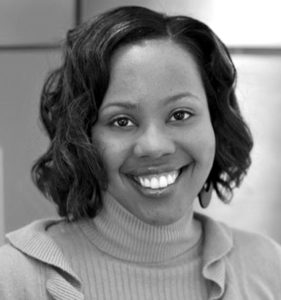
Summer Owens

Summer Owens’ childhood ended when she got pregnant on her 15th birthday.

Rather than become a silent statistic of poverty and ignorance, though, she has become a voice of warning and encouragement to young people everywhere. She tells her story in public speeches, on television and in the book she wrote and published titled Life after Birth: A Memoir of Survival and Success as a Teenage Mother.

The story begins with an encounter with an older guy in her hometown of Bolivar. They were fooling around. She was a virgin, a sophomore in high school. No adult in her world had ever talked to her about sex or the consequences of sexual activity. She let him touch her. He went further. What happened didn’t even feel to her like completed sex.

Four weeks later she went to a health clinic to get checked for STDs and tests showed she was pregnant. “Nobody ever talked to me which is why I talk now to girls – and boys – because it seems it is difficult for parents to talk,” Summer says.

With younger siblings at home and a stepfather with whom she had conflict, Summer moved in with her grandmother in Jackson. After her baby boy Jaylan was born, Summer was out of school for six weeks. When she went back to class at Jackson Central-Merry High School she had to catch up in chemistry, French and geometry while studying the current six weeks’ material.

Her grandmother, then 75 years old, helped with the baby. Her typical routine: Up at 5 to prepare Jaylan’s bottles. Off to school and then to after-school student government, Beta Club and yearbook meetings. Home to tend the baby and do some homework. Off to Arby’s to work as a cashier. Return home to tend the baby. Drop into bed around midnight. Repeat. She soon added a weekend job as hostess at Waffle House because, as she learned, babies cost a lot.

Her hard work and intelligence paid off! She graduated eighth in her class of about 300 and was elected Most Likely to Succeed! When she won an Emerging Leaders Scholarship to the University of Memphis, she left Jaylan with her grandmother and moved on campus for her freshman year, going home every weekend. Jaylan sometimes visited in the dorm and went to class with Summer. He learned his numbers and letters sitting in class.

In her sophomore year, Summer rented an apartment and found daycare for Jaylan. Roommate, faculty secretaries, even program directors helped with Jaylan when she wasn’t there. In 2001, Summer was named Miss University of Memphis – based on campus and community involvement and academic achievement. She graduated with a marketing major, magna cum laude.

That’s when Summer went to work in ticket sales for the Memphis Grizzlies. She pursued a master’s in business administration from Bellhaven University while rising to the position of marketing manager for the Grizzlies. She worked 70 to 80 hours a week, saved money and bought her first house in Bartlett.
In 2006, she joined ServiceMaster as a marketing manager and in 2007 joined the marketing staff at FedEx Corp where she today holds the position of senior marketing specialist.

Over the years, Summer’s friends wanted to know how she managed to accomplish so much when so many teen moms don’t. The questions led to her self-published memoir, which she began promoting on Facebook. Requests for speaking engagements soon rolled in from youth groups, school groups, even college. Now she has a website, publishes an online newsletter and volunteers as a mentor through Memphis City Schools.

Summer is the mother of a 17-year-old, now, and offers clear guidance to adults and teens: “It is our responsibility to love, nurture and educate our youth so that they can make responsible choices with regard to their sexual behavior,” she says. “We do live in a world where girls and boys are having sex, and they need to know (that) if this is the choice you make, these are the consequences.”

In her website and her presentations – from Frayser to Texas to Kentucky, from Channel 3 Live at Nine to CNN – Summer Owens urges parents to talk to children about pre-marital sex, teach them about making good choices. And she urges teens who have become parents to make their lives the best they can be, heroically using her own story of pregnancy and hard work to warn, guide and motivate today’s teens.

We thank her with the 2012 Women of Achievement award for Heroism.